* All product/brand names, logos, and trademarks are property of their respective owners.
The gap between being a good manager and being a great leader has never been more consequential than it is in 2026.
Global employee engagement has dropped to 20% its lowest level since Gallup began tracking, down from a peak of 23% in 2022. Manager engagement specifically fell five points between 2024 and 2025. Only 29% of employees trust their direct manager, and 28% of employees who quit cite a poor relationship with their manager as the primary reason for leaving. These are not abstract statistics. They represent the measurable cost of a leadership capability gap that is widening as demands on managers grow more complex.
The business environment managers navigate in 2026 is fundamentally different from five years ago. Hybrid and remote teams are the default. AI tools are reshaping how work gets done. Employee expectations around transparency, development, and psychological safety have risen sharply. Traditional management skills task delegation, process oversight, performance tracking remain necessary but are no longer sufficient. The managers retaining talent and driving performance in 2026 are developing a more expanded set of capabilities. Here is what those look like.
Emotional intelligence the ability to recognize, understand, and manage one's own emotions while reading and responding effectively to the emotions of others consistently emerges as the most impactful leadership competency across research. It explains 58% of performance across every job type measured, according to data from TalentSmart. Not technical expertise. Not strategic thinking. Not communication skills. Emotional intelligence.
For managers in 2026, emotional intelligence is the operating system everything else runs on. It determines how effectively a manager handles conflict, gives difficult feedback, navigates organizational uncertainty without transmitting anxiety to the team, and builds the kind of psychological safety that allows people to speak up, take risks, and contribute at their highest level.
Only 24% of employees currently feel psychologically safe at work, according to the Achievers Workforce Institute. Managers are the primary variable in whether psychological safety exists on a given team or not because it is built through behavior, not policy. Teams where managers demonstrate consistent emotional regulation, genuine curiosity about team members' perspectives, and follow-through on what they say build trust over time. Teams where managers are reactive, inconsistent, or dismissive do not regardless of what the organization's stated values say.
Developing emotional intelligence is deliberate work. It requires regular self-reflection, soliciting honest feedback from peers and direct reports, and building practices pause before reacting, listen to understand rather than respond, acknowledge emotions before moving to solutions that become habitual under pressure, not only in calm conditions.
Research is clear on the cost of poor communication in organizations. Unclear communication causes projects to miss deadlines despite competent teams, cross-functional initiatives to stall due to misalignment, and strategies to fail not from poor thinking but from poor understanding. In 2025, 37% of employees reported insufficient communication from leadership, and 65% said leadership failed to communicate a clear vision for the future.
Strategic communication is not about how much a manager communicates. It is about how clearly and consistently information, context, and direction are translated into shared understanding that teams can act on. Two things matter most.
The first is the ability to connect daily work to organizational purpose. People who understand how what they do contributes to something meaningful are four times more likely to feel purposeful at work, according to McKinsey research. Managers who create that connection not as an annual speech but as a consistent thread in how they communicate about work drive engagement levels that cannot be manufactured any other way.
The second is creating genuine dialogue, not just broadcasting information. Employees who spend six hours per week interacting with their manager are 29% more inspired and 30% more engaged than those who interact for only one hour weekly, according to Leadership IQ research. The quality of those interactions matters as much as the quantity but the cadence has to exist for the quality to develop. Weekly one-on-ones, team check-ins with space for real conversation, and manager visibility and accessibility are not administrative overhead. They are the primary lever for sustained team performance.
The half-life of professional skills continues to shrink. Organizations are undergoing technology transformation, structural reorganization, and strategic pivots at a pace that was unusual five years ago and is now routine. Managers in 2026 who lead teams through change effectively are among the most valuable people in any organization.
Adaptive leadership is the ability to guide a team through uncertainty and disruption while maintaining operational effectiveness and team cohesion. It requires two distinct capabilities that must coexist: clear, honest communication about what is changing and what remains stable, and genuine flexibility in adjusting how support, structure, and prioritization work as circumstances evolve.
Managers who communicate clearly during change naming what is uncertain, committing to what is known, and explaining the rationale behind decisions significantly reduce the anxiety and rumor that fill information vacuums when leaders go silent during transitions. Managers who also adapt their support levels based on team members' varying readiness for change some need more structure, others need more autonomy sustain performance through transitions where rigid approaches generate resistance and disengagement.
AI fluency has moved from a technical advantage to a basic leadership competency. Managers who do not understand what AI tools can and cannot do are already making decisions about workflows, team structure, hiring, and tool adoption that would be better-informed if they did.
In 2026, this does not mean managers need to be data scientists. It means they need to understand which tasks on their team are candidates for AI-assisted automation, how to evaluate AI tool selection for their specific workflows, how to communicate the purpose and boundaries of AI adoption clearly to their teams, and how to redirect the capacity that automation frees toward higher-value human work.
FranklinCovey's 2026 leadership research identifies leveraging AI appropriately as one of the eight critical leadership goals specifically because managers who use AI for scheduling, data synthesis, communication management, and workflow automation recover significant time for strategic decision-making and team development. The managers who resist AI adoption entirely are not preserving their teams' jobs. They are falling behind peers who are becoming more capable, faster.
Equally important is managing how AI affects team dynamics and individual concerns. Employees who fear AI-driven displacement need clear, honest communication from their managers about the organization's intent and the role of human judgment in the work that remains. That conversation requires both AI literacy and the emotional intelligence to have it well.
One of the clearest shifts in what distinguishes effective managers in 2026 is the move from directing telling people what to do and how to do it to coaching asking questions, creating space for thinking, and developing the capability of the team over time.
The business case for this shift is strong. Leaders who support their teams have 3.4 times more engaged workers, according to Inpulse research. Teams receiving weekly check-ins report 21% higher engagement than those relying on quarterly or annual conversations. Employees who understand how they can progress and develop internally are 3.5 times more engaged than those without visibility into growth opportunities.
A coaching approach to management means being genuinely curious about how each team member thinks, identifying development opportunities within regular work rather than treating growth as a separate annual process, giving feedback that is specific, timely, and forward-looking rather than retrospective and evaluative, and knowing when to challenge someone past their comfort zone versus when to offer support and structure.
This does not mean managers avoid decisions or direction. It means the default orientation shifts from solving problems for people to building the capability of people to solve problems themselves which produces compounding returns in team performance over time.
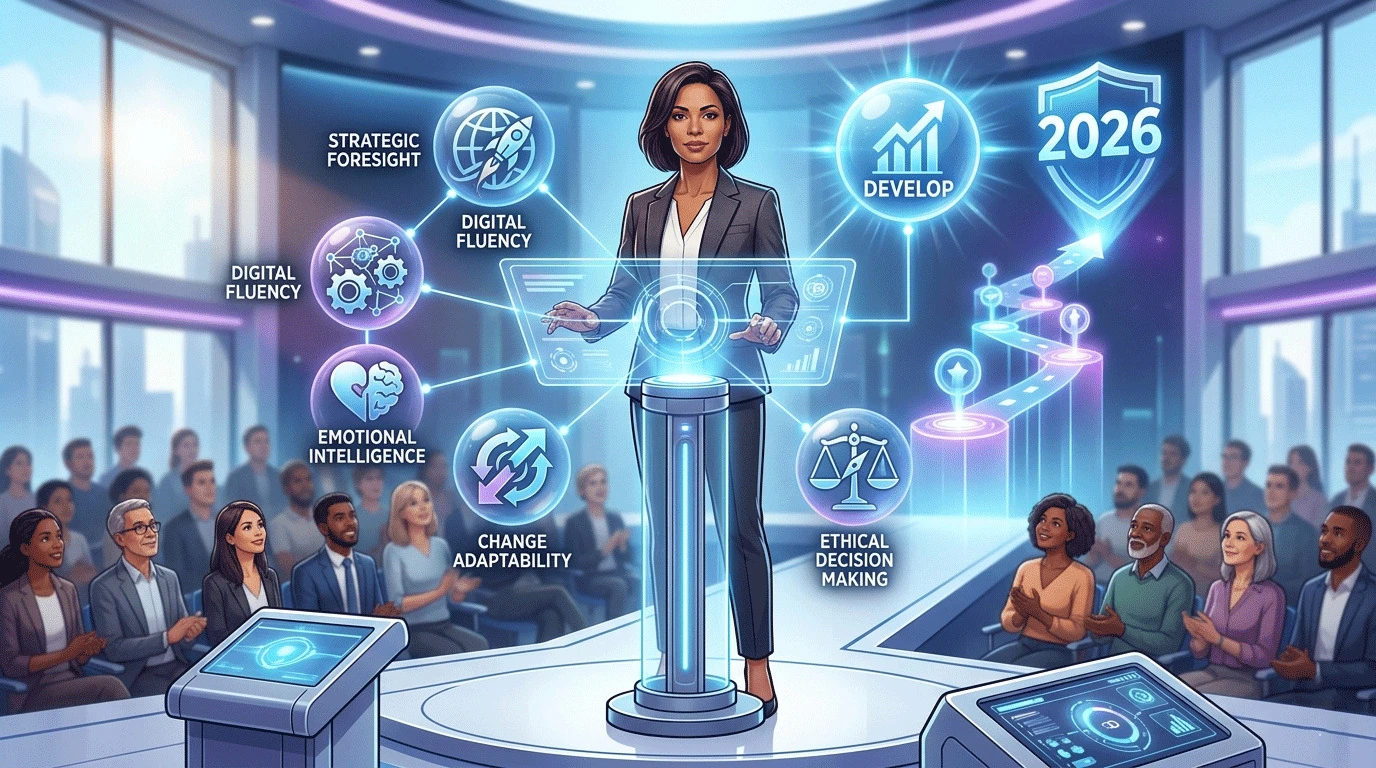
The leadership skills that produced good managers in previous decades are a starting point, not a destination, in 2026. Emotional intelligence, strategic communication, adaptive change leadership, AI literacy, a coaching orientation, and a commitment to continuous learning are the competencies that separate managers who are building high-performing, engaged, resilient teams from those who are managing activity and wondering why retention and performance are suffering.
The good news is that none of these are fixed traits. Every one of them is developable through deliberate practice, honest feedback, and the same growth mindset managers need to model for the teams they lead.

I’m an SEO specialist passionate about helping websites grow and stand out in search results. From keyword research to content strategy and on-page optimization, I use data-backed techniques to increase organic traffic and build long-term visibility.
Stairs are one of the most common places for slips, trips, and falls in commercial buildings. That's
17 August 2026
Workplace wellbeing used to be treated as a nice-to-have. A fruit bowl in the break room, a poster a
22 April 2026
Energy costs have become a real concern for many homeowners. Whether it is a smaller flat in the UK
16 March 2026
Be the first to share your thoughts
No comments yet. Be the first to comment!
Share your thoughts and join the discussion below.
.webp&w=3840&q=75)





.webp&w=3840&q=75)