* All product/brand names, logos, and trademarks are property of their respective owners.
AI tools that once required enterprise-level budgets and dedicated data science teams are now cloud-based, subscription-priced, and designed to work without technical expertise. According to recent research, 98% of small businesses are now using AI daily, with 91% crediting it for growth and 87% reporting measurable operational improvements. The International Data Corporation projects global AI spending growing at over 27% annually and while much of that investment comes from large firms, small businesses are adopting at a pace that is rapidly closing the capability gap.
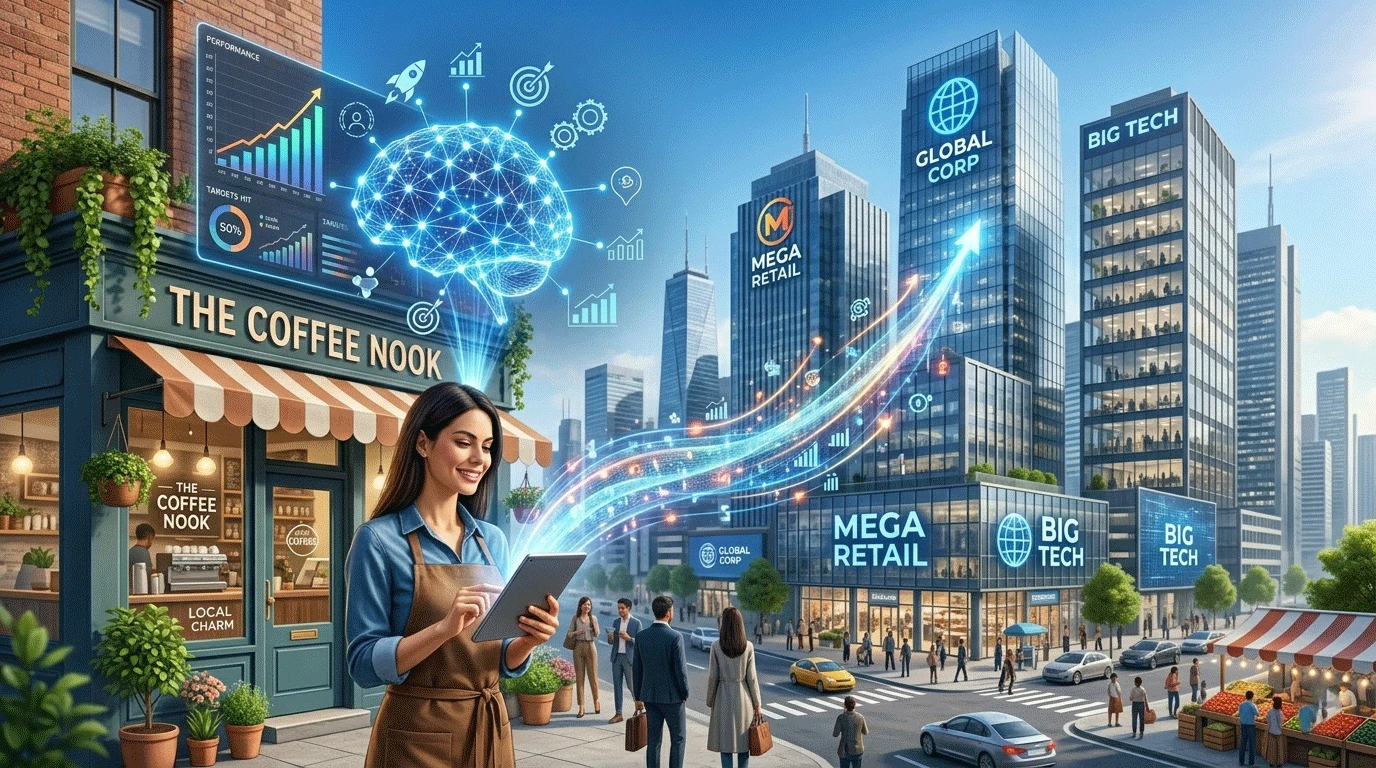
The question is no longer whether small businesses can access AI. It is whether they are using it strategically enough to change their competitive position.
One of the clearest historical advantages large corporations held over small businesses was the ability to provide round-the-clock customer service. A national brand could staff a call center. A local business could not.
AI has eliminated that gap entirely. AI-powered chatbots and virtual assistants now handle customer queries, qualify leads, process returns, and resolve standard support issues at any hour without any human intervention required outside of business hours. The financial case is compelling at every scale: the cost per customer interaction has dropped 68%, from $4.60 to $1.45, after AI implementation in customer service operations. Businesses adopting AI-driven support solutions report a 25% reduction in overall customer service costs, with first response times improving from over six hours to under four minutes.
For a small business with five staff members handling customer service, this is transformative. The team that was spending 60% of its time on repetitive, answerable queries can redirect that capacity toward complex issues, relationship-building, and sales activities that require genuine human judgment. The AI handles the volume. The team handles the nuance. The customer experience measured by response speed, availability, and satisfaction scores improves across all three dimensions simultaneously.
Large corporations have invested hundreds of millions of dollars in marketing technology that personalizes campaigns at scale customer segmentation engines, predictive analytics platforms, dynamic pricing tools, and real-time behavioral targeting systems. In 2020, those capabilities were genuinely out of reach for most small businesses. In 2026, the same capabilities are available through affordable cloud-based platforms that require no data science team to operate.
AI-powered marketing tools analyze customer behavior, purchase history, browsing patterns, and engagement data to build precise audience segments and deliver personalized messages automatically. AI-based segmentation has produced a 33% uplift in personalization effectiveness, while brands using AI clustering models have seen a 26% increase in campaign conversion rates. AI-powered recommendation engines now drive 31% of e-commerce revenue across the industry and small retailers using these tools are generating those returns alongside the national chains.
Consider what this means in practice for a small business owner. Instead of sending the same email campaign to the entire customer list and hoping for a 2% open rate, an AI-powered email tool segments the list by purchase behavior, sends different messages to different groups at the optimal time for each, and continuously learns which content drives engagement. The result is marketing performance that was previously achievable only by teams with dedicated analytics resources now accessible through a monthly software subscription.
Canva's AI design tools are already used by 54% of small business marketers. HubSpot, Jasper, and a growing ecosystem of AI-native marketing platforms are purpose-built for teams without dedicated creative departments. The output quality, the targeting precision, and the campaign speed available to a two-person marketing operation in 2026 would have been unrecognizable to the same business five years ago.
Beyond customer-facing applications, AI is delivering significant operational value inside small businesses by automating the repetitive administrative work that consumes disproportionate time in lean teams.
Invoicing, payroll processing, expense categorization, inventory management, appointment scheduling, data entry these tasks have always required either employee time or expensive specialist support. AI-powered accounting tools like QuickBooks and Xero now handle much of this automatically, flagging anomalies and generating reports without manual input. AI inventory systems use predictive models to optimize stock levels and reduce carrying costs. Scheduling tools manage bookings and reminders without any staff involvement.
The cumulative time savings are significant. Research indicates AI can reduce administrative workload by 20 to 30%, representing many hours per week for a small team that is already stretched thin. For a business with limited payroll, recapturing that time and redirecting it toward revenue-generating activities is the equivalent of adding staff capacity without the hiring cost.
The broader operational benefit is consistency. Large corporations invest heavily in process standardization because consistent execution at scale is what makes them reliable. AI-powered workflow automation gives small businesses that same consistency without the organizational overhead standard processes execute the same way every time, without depending on which employee happens to be working that day.
Large corporations make decisions backed by sophisticated analytics infrastructure dashboards that pull from multiple data sources, models that forecast demand and identify risk, real-time performance tracking across every business unit. Small businesses have historically made decisions based on intuition, spreadsheets, and delayed financial reports.
AI is changing the accessibility of data-driven decision-making dramatically. Modern AI analytics tools ingest data from sales platforms, marketing channels, customer records, and financial systems and surface insights in plain language without requiring the user to know anything about data analysis. A small business owner can now ask their analytics tool why sales dipped last month and receive a data-backed explanation that identifies the specific products, channels, or customer segments responsible.
Predictive analytics forecasting demand, identifying customers at risk of churning, spotting seasonal patterns is no longer an enterprise-only capability. Small businesses using AI analytics tools are making faster, more accurate decisions across inventory, marketing, pricing, and hiring. Business leaders who integrate AI-powered insights report up to 30% improvement in key business metrics compared to competitors who still rely on intuition and lagging indicators.
Here is where small businesses have always had a structural edge over large corporations and where AI amplifies that advantage most dramatically.
Large organizations move slowly. Decisions require approval chains. New tools require procurement processes. Campaigns require multi-department coordination. A marketing test that takes a small business one afternoon to launch can take a large corporation three months of internal alignment.
AI accelerates execution for small businesses in ways that large organizations struggle to match quickly. A small business can deploy a new AI chatbot, launch a personalized email campaign, implement an AI-powered pricing adjustment, and test a new content strategy all within a week. A corporation faces organizational friction at every one of those steps.
"AI has moved from a tool to a strategic asset for small businesses aiming to stay resilient and grow in 2026," according to Sharat Raghavan, Economist and Director of Research at LinkedIn. The new competitive edge is not budget or headcount. It is AI literacy knowing which tools to use, deploying them quickly, and iterating based on results faster than larger competitors can respond.
AI has leveled the playing field significantly, but it has not made it entirely flat. Large corporations still have advantages that small businesses need to be clear-eyed about.
Brand recognition built over decades does not disappear because a small business deploys a better chatbot. Distribution networks, supplier relationships, and retail shelf space are not disrupted by AI marketing tools. Enterprise-grade cybersecurity infrastructure, compliance capabilities, and legal resources remain more accessible to large organizations with dedicated teams and larger budgets.
The strategic implication is not that AI makes competition with large corporations effortless. It is that AI removes barriers that previously made certain competitions impossible particularly in customer experience, marketing sophistication, operational efficiency, and data-driven decision-making. Small businesses that combine AI capability with the authentic relationships, local knowledge, and organizational agility that large corporations cannot replicate are the ones finding the most durable competitive ground.
The competitive gap between small businesses and large corporations is narrowing in 2026 and AI is the primary engine of that shift. Customer service that was once cost-prohibitive is now accessible through affordable subscriptions. Marketing personalization that required dedicated analytics teams now runs automatically on platforms designed for non-technical users. Operational efficiency gains that large businesses achieved through expensive infrastructure are now available to businesses with ten employees.
The small businesses winning in this environment are not the ones with the biggest AI budgets. They are the ones that identified where AI creates the most leverage in their specific operation, deployed it quickly, and combined it with the genuine competitive advantages that only small businesses can offer agility, authenticity, and the kind of customer relationships that no algorithm can replicate.

I’m an SEO specialist passionate about helping websites grow and stand out in search results. From keyword research to content strategy and on-page optimization, I use data-backed techniques to increase organic traffic and build long-term visibility.
The American apparel market thrives on individuality, premium quality, and brand identity. From
26 September 2026
Security problems can affect a business without warning. An unauthorized person may enter a facility
8 September 2026
The revolution of AI-powered sorting robots is reshaping recycling, logistics, manufacturing, and ma
21 August 2026
Be the first to share your thoughts
No comments yet. Be the first to comment!
Share your thoughts and join the discussion below.





.webp&w=3840&q=75)