
* All product/brand names, logos, and trademarks are property of their respective owners.
The conversation around automation has been distorted by fear for years. Employees hear "automation" and think job cuts. Managers read the same statistics: 85 million jobs displaced globally by 2025, 43% of businesses planning to reduce headcount through technology and assume the choice is binary: either automate and downsize, or stay manual and stay competitive.
That framing is wrong. And the companies that have moved past it are outperforming the ones still stuck in it.
The most effective automation programs in 2026 are not headcount reduction initiatives dressed up in technology language. They are operational upgrades that eliminate the work nobody wanted to do in the first place, free skilled people to focus on what they are actually good at, and scale output without scaling costs. Research from McKinsey found that organizations combining AI with business process automation are seeing 20 to 30% reductions in operational costs and over 40% improvements in efficiency not by replacing their teams, but by redirecting them.
Here is how to build an automation strategy that delivers those results without triggering the resistance, resentment, and talent loss that come with getting it wrong.
The most important question in any automation initiative is not "what can we automate?" It is "what work should never have required a human in the first place?"
Data entry. Chasing approvals. Sorting and routing emails. Copying information between systems. Formatting reports. Generating routine invoices. These are tasks that consume significant employee time. Research shows employees spend nearly 62% of their working day on repetitive, automatable tasks, but contribute nothing to the quality of the output or the strength of the customer relationship. They are administrative overhead that got assigned to skilled people because there was no alternative.
When automation targets this category of work first, resistance drops immediately. Nobody defends the right to spend three hours a day on data entry. Nobody mourns the loss of the task where they manually copy order details from one system to another. Starting with genuine friction, the tasks that drain energy and produce no intellectual satisfaction build early goodwill for the automation program rather than fear of it.
The fastest way to trigger workforce anxiety about automation is to roll it out as a decision made above people's heads, without their input. The most effective way to build a sustainable automation program is to involve the people closest to the work in identifying where it should happen.
Frontline employees know where the friction is. They know which tasks are purely mechanical repetition. They know which steps exist only because no one ever questioned whether they needed to. They also know which parts of their work require genuine judgment, relationship, creativity, or context that cannot be systematically captured, and those are exactly the areas where automation has no business reaching.
Run structured process documentation sessions by department. Go through recurring tasks and classify them honestly: Does this require human judgment? Does it involve relationship-building or customer-facing interaction? Does it demand creativity or strategic thinking? If the answer to all three is no, it is a candidate for automation. If any of those elements are present, it is not.
This exercise does two things simultaneously. It maps the automation roadmap accurately. And it demonstrates to the team that the goal is to eliminate tedious work rather than valuable people.
Some categories of business process consistently deliver the clearest automation returns, regardless of industry or company size.
Invoice and payment processing. Generating, sending, and reconciling invoices is rule-based, high-volume, and error-prone when done manually. Automated invoice workflows eliminate manual entry errors, speed up payment cycles, and free finance staff for analysis rather than data handling. Accenture estimates that up to 80% of a finance department's transactional workflow is automatable.
Employee onboarding and offboarding. Creating accounts, assigning training, collecting documents, and configuring access permissions, these steps follow a predictable sequence that varies only by role. Automation ensures new employees are fully set up from day one rather than waiting days while manual processes slowly catch up. The experience improves for the new hire, and the administrative burden on HR drops significantly.
Customer support triage. AI-powered chatbots and intelligent ticket routing systems handle first-contact questions, collect initial information, categorize issues, and route complex cases to the right human specialist. The support team handles the situations that genuinely require judgment and empathy. Response times drop and team bandwidth expands without reducing the quality of human interaction where it matters most.
Approval workflows and internal requests. Purchase approvals, time-off requests, expense submissions, and document sign-offs. Most approval processes are purely sequential and follow fixed rules. Automating them eliminates the approval bottlenecks that quietly slow operations without anyone realizing the cumulative cost.
Reporting and performance dashboards. Pulling data from multiple sources, formatting it, and distributing it manually is a significant time sink for operations, sales, and finance teams. Automated reporting pipelines deliver accurate, formatted dashboards on schedule without anyone touching a spreadsheet.
The most common reason automation programs underdeliver is not technical failure. It is human failure, specifically, failure to invest in helping people understand what changes, what stays the same, and what they are expected to do differently.
Over a third of workers express active concern about automation-related job loss. That anxiety does not disappear when automation is introduced positively; it has to be addressed directly and continuously. Communication needs to explain not just what is being automated, but why, and explicitly what happens to the roles and responsibilities of the people affected.
In practice, this means redirecting the time recovered through automation into visible, valued new activities. If the finance team saves fifteen hours a week through automated reconciliation, those fifteen hours need to go somewhere that the team members and their managers can point to as meaningful work. Forecasting. Vendor relationship management. Financial analysis. Strategic planning. If the recaptured time just quietly disappears into general busyness, the automation investment underperforms, and the workforce never develops confidence in the program.
The World Economic Forum's Future of Jobs Report found that 85% of employers plan to prioritize upskilling their workforce through 2030, with 63% identifying skill gaps as the biggest barrier to business transformation. The companies building automation sustainably are investing equally in the tools and the people who will work alongside them. Studies show that it costs 70 to 92% less to upskill an existing employee than to hire a new one, which makes workforce development not just an ethical choice but an economically rational one.
One of the most significant developments in automation over the past few years is the expansion of no-code and low-code platforms that allow non-technical employees to build and modify their own automated workflows without relying on a developer for every change.
Zapier, Make, and Microsoft Power Automate all enable business users to connect applications, set triggers, and build multi-step automations through visual interfaces. When the marketing team can automate their own lead follow-up workflow without waiting for an IT ticket, they feel ownership over the automation rather than being subject to it. That shift in psychological framing from automation happening to me to automation I built is one of the most powerful tools available for reducing resistance and building capability simultaneously.
Empowering teams to own and iterate on their own automations also accelerates improvement cycles. The people who understand the process best are the ones refining the automation, rather than submitting requirements through a change management process and waiting months for updates.
Automation does not have to be a workforce reduction program. It does not have to trigger fear, resistance, or resentment. When done with intention, starting with the right tasks, involving the team in the process, investing in transition and upskilling, and being clear about what stays human, it is one of the most powerful tools available for building a business that is faster, more efficient, and more satisfying to work in.
The goal is not a smaller team. It is a more capable one. And the companies figuring that out in 2026 are the ones pulling ahead of competitors, still treating automation as a choice between people and technology.

I’m an SEO specialist passionate about helping websites grow and stand out in search results. From keyword research to content strategy and on-page optimization, I use data-backed techniques to increase organic traffic and build long-term visibility.
The American apparel market thrives on individuality, premium quality, and brand identity. From
26 September 2026
Security problems can affect a business without warning. An unauthorized person may enter a facility
8 September 2026
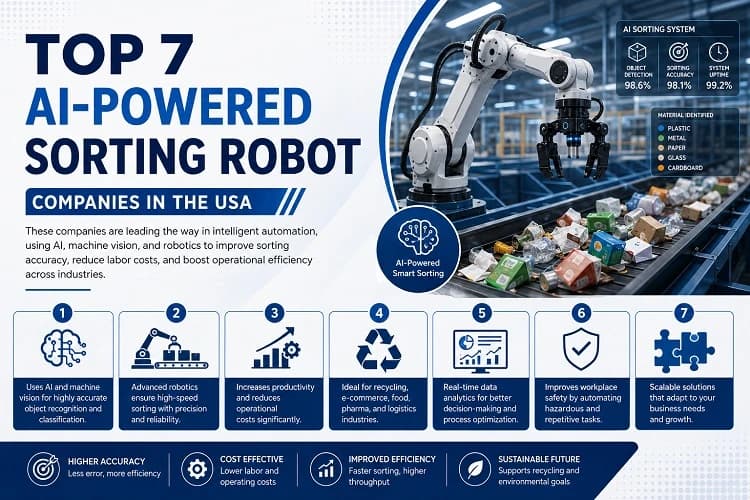
The revolution of AI-powered sorting robots is reshaping recycling, logistics, manufacturing, and ma
21 August 2026
Be the first to share your thoughts
No comments yet. Be the first to comment!
Share your thoughts and join the discussion below.




.webp&w=3840&q=75)