* All product/brand names, logos, and trademarks are property of their respective owners.
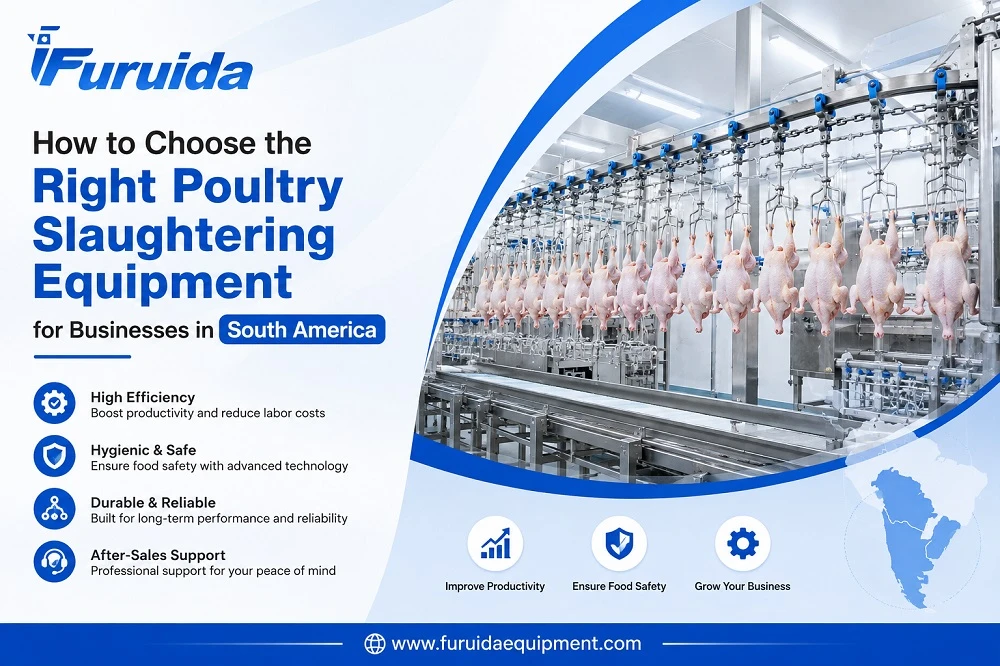
Poultry processing is serious business in South America. Although Brazil is the world's largest chicken exporter, Argentina runs close to a thousand federally inspected plants. While Chile, Colombia, and Peru are all scaling domestic processing capacity. The equipment decisions you make now, compliance, and your margins decide the output for the next decade.
This guide discusses what is necessary when choosing poultry slaughtering equipment for a South American operation.
You need a number before you look at any machine. How many birds per hour (BPH) do you need to process?
You can work it out in the following way.
For example, a plant targeting 4,800 birds in an eight-hour shift needs a line of 600 BPH minimum. The most common mistake by many businesses is buying poultry slaughtering equipment to match the current volume. It does not allow room for growth.
Capacity also helps in determining whether a semi-automatic or fully automatic line makes more sense.
Poultry slaughtering equipment in South America must comply with the food safety and inspection frameworks in your country. It is non-negotiable. The two largest markets have specific requirements.
You can ask manufacturers whether their equipment has been installed in MAPA- or SENASA-compliant facilities before. A manufacturer with this kind of experience will understand the documentation and configuration requirements better. You may have to figure it out yourself if the manufacturer has no prior experience with this regulation.
The poultry slaughtering equipment is not configured in the same way. The machines you buy should be able to handle the species and size of bird you process.
You will end up with poor defeathering results if you buy a broiler line and run ducks through it, which can cause potential equipment damage.
Poultry slaughtering equipment spends its working life in wet, high-temperature, and high-contact environments. Therefore, it makes sense to look at the material specification.
Look for the following material specifications.
Hygiene is a layout issue, too. You can ask manufacturers whether they can advise on placing equipment to maintain a clean and dirty zone separate throughout the processing flow. It is also a requirement in MAPA- and SENASA-compliant facilities.
Most manufacturers offer catalogue configurations and custom builds. They both have a place, depending on your situation.
Standard equipment is for buyers whose facility dimensions, power supply, and processing requirements fall within typical ranges. Lead times are shorter, and pricing is more predictable.
Customised equipment is worth the additional lead time in the following cases.
A good manufacturer will ask you detailed questions about your facility before recommending a configuration. If they jump straight to a product recommendation without asking about your setup, treat that as a red flag.
The upfront cost of poultry slaughtering equipment is only one part of the total investment. Several other costs add up over a period of five- to ten-year operating life.
Choosing poultry slaughtering equipment for a South American business is an operational decision. You can get the return on your investment when you plan the capacity, follow the compliance requirements, build quality, and the manufacturer you partner with. So, take the time to assess all of the factors carefully. It will help you avoid the expensive corrections that come from rushing the decision.
Are you ready to discuss your requirements? Contact the Furuida team for a configuration recommendation built around your capacity, facility, and budget.

Vipul Mishra is a confident and positive individual who values personal growth, meaningful connections, and new experiences. He believes in staying genuine, focused, and optimistic in every aspect of life.
Walk into almost any building — a new-build home, a renovated flat, a commercial unit —
1 September 2026
Industrial diesel engines are essential to the functioning of many businesses, from sites of constru
20 August 2026
The purchase price of industrial equipment is rarely the most important number in the decision. It i
24 April 2026
Be the first to share your thoughts
No comments yet. Be the first to comment!
Share your thoughts and join the discussion below.





.webp&w=3840&q=75)