* All product/brand names, logos, and trademarks are property of their respective owners.
You ask your child what they have been doing, and the answer is the same as yesterday: playing a game. It can be tempting to end the conversation there. Yet if you ask about one detail, you may hear something more specific. They noticed a clever level, argued about an unfair rule, or spent time choosing how a character should look.
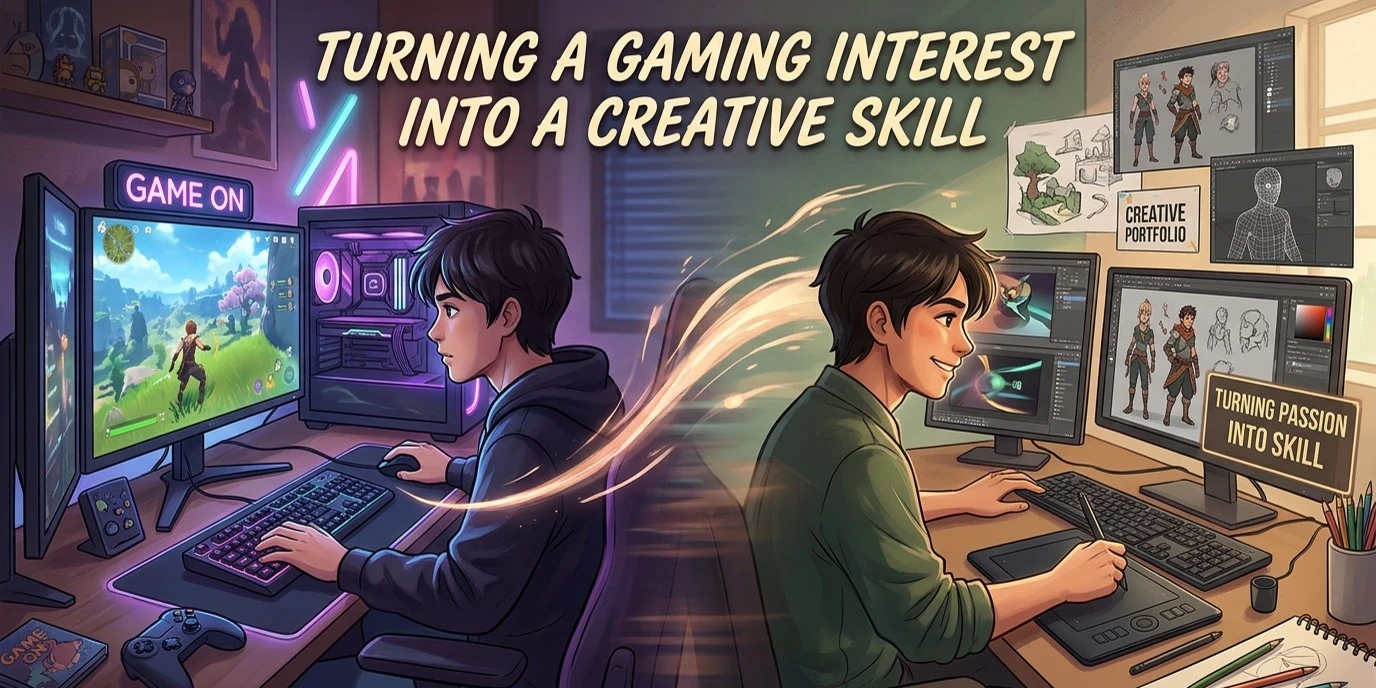
Those observations can become the beginning of a creative activity. The goal is not to disguise every game as homework or justify unlimited play. It is to notice an interest and offer a small way to make something with it. A child can enjoy playing and also discover that they have ideas worth trying outside the game.
Ask your child to explain one part they find interesting. It might be the music, the way a character moves, a puzzle, or a story choice. Stay with that detail long enough to understand why it matters to them before suggesting an activity.
Avoid assuming that every interested player wants to learn programming. A child may be drawn to drawing, writing, sound, organizing a group, or explaining strategies. Those interests are different, and a useful invitation follows the one the child actually has.
You do not need to understand the whole game. Ask what the player is trying to do and what makes the task satisfying or frustrating. A genuine question can reveal more than an adult announcement that gaming time must now become productive.
Choose a project that can be completed with ordinary materials. A child might sketch an original character, design a paper maze, record a short sound effect, or write a different ending for an invented story. Keep it separate from copying or distributing someone else's protected material.
Define a finish before beginning. One character sheet or one playable paper challenge is enough. If the first idea becomes too large, ask which part the child wants to try today. The rest can remain a possibility rather than a growing list of obligations.
Let the child decline. An invitation loses its meaning if it becomes a condition for being allowed to enjoy the game. You can maintain household limits while leaving creative exploration voluntary. Another day or a different kind of project may fit better.
A paper game is a useful starting point because it makes decisions visible without requiring a new account or software installation. Ask the child to choose an objective, a way to take turns, and an ending. Use simple objects already available at home.
Play one round together and notice where the instructions become unclear. Perhaps a player does not know what happens after a tie. Perhaps the game ends too quickly. Treat those moments as design questions rather than proof that the idea failed.
Let the child decide what to change. You can explain your experience as a player without rewriting the whole game. The result belongs to them when they can connect a change to a problem they noticed and explain why they chose that solution.
A child may respond to a problem by adding more rules, characters, or effects. Pause and ask whether a smaller change would help. Sometimes the useful next step is making one instruction clearer rather than making the project larger.
Harvard Project Zero's Agency by Design research explores maker-centered learning through attention to how things are designed and how people can change them. It offers background for asking children to examine a system and notice opportunities. This family activity is a practical suggestion, not a claim that one game project delivers measured educational results.
The question can remain ordinary: what is this part doing, and what happens if we change it? That kind of attention helps the child move from admiring a finished experience to noticing the choices behind it.
If the interest is visual, begin with sketches. Ask the child to design an original object or character for an imagined world. Discuss what the shape, clothing, or colors communicate. They can make a small change and compare the effect without needing professional software.
For sound, try recording a few household noises in an appropriate setting. Ask which sound could suggest a door opening or an object moving. Keep recordings free of private conversations and obtain permission from anyone whose voice would be included.
Use available tools and check any new service's age, account, and privacy requirements. Expensive equipment is not the starting point. A modest project lets the family discover what the child enjoys before spending money or creating a public profile around the interest.
A child who talks about game characters may enjoy inventing a short scene. Ask what the character wants and what makes that difficult. One conversation or choice is enough; there is no need to plan an entire fictional universe.
Encourage original material rather than copying a familiar character's biography. A child's gaming experience can inspire questions about pacing, choices, and consequences without reproducing someone else's work.
Read or act out the scene together if the child wants. Ask whether the audience understands the choice and what information is missing. Keep feedback connected to the intended effect rather than over-correcting until the child's voice disappears.
If the child wants to move from paper to a digital tool, identify what the tool will help them do. It might make revision easier or allow a simple animation. Choose a suitable service under its current rules and keep the first task small enough to understand.
Do not promise that learning one tool will lead to a particular career or income. A child can develop an interest without being assigned a future profession. The value of the activity can be that they tried an idea and learned how to make a choice visible.
If an age-appropriate AI tool is involved, keep the child's contribution clear. They should decide what fits the project and review factual material rather than accepting output simply because it is polished. Follow school rules if the work later becomes part of an assignment.
Parents sometimes divide screen activities into passive entertainment and valuable creation. Real use is less tidy. A child may watch a demonstration, play a game, discuss an idea, and then make something. The movement between those activities can be more useful to notice than a rigid label.
TheOneSpy's illustrated journey from digital consumption to possible future creation uses broad eras from 2010 to 2035 to prompt that discussion. The periods overlap, and the future scenes are speculative. They can help a family ask how tools change while decisions about purpose, audience, and responsibility remain.
Ask your child which parts of their gaming interest could become an experiment they control. The answer might be a small drawing or a rule change, not a business or an ambitious app. Keep the next step connected to today's curiosity.
A finished game or drawing can stay in the family; public sharing is a separate decision involving age requirements, privacy, permission, and readiness for feedback. A project does not need a public audience to count as complete.
If your child wants feedback, ask a trusted sibling or relative to respond to the work itself—like checking if instructions are clear—which is more useful than an unpredictable audience.
Be alert to offers demanding money, private contact, or personal information. A child doesn't need a stranger's promise of promotion to take their work seriously; always pause and evaluate opportunities with a trusted adult.
Creative projects still require device boundaries. Agree on time limits, breaks, and how to save work so your child doesn't fear losing progress when stopping. Avoid claiming all gaming is now educational; let simple entertainment remain entertainment without forcing a developmental purpose onto every activity. Afterward, review how the experiment felt—whether they enjoyed making decisions, if the tool caused frustration, or if paper would have worked better—to guide future attempts.
Ask your child to share one decision they are proud of, like a simplified rule or a character detail, and listen without immediately offering improvements. This shifts the conversation from screen time to creative choices, offering insight into their interests. A gaming hobby doesn't need to be a career path; a manageable project simply helps a child discover how the experiences they enjoy are built.
Harvard Graduate School of Education, Project Zero, Agency by Design project overview (consulted November 5, 2026) informs the maker-centered learning approach. Suggested projects are original ideas, not tested interventions or career forecasts. The linked TheOneSpy timeline is an illustrative editorial resource.

Government contracting can open new opportunities for businesses, but the process can feel complicat
10 September 2026
Artificial Intelligence is becoming an important part of modern education. Students already interact
21 August 2026
Be the first to share your thoughts
No comments yet. Be the first to comment!
Share your thoughts and join the discussion below.